Water—vital and mysterious—has always played a central role in ancient cultures. In Sardinia, during the Nuragic age, water was not merely a resource for daily survival; it became an object of worship. This is evidenced by the many sacred wells scattered across the island, among which the Sacred Well of Santa Cristina Archaeological Site, in Paulilatino, stands out as one of the masterpieces of Nuragic architecture.
What rituals took place in these spaces? And what did the cult of water mean for Nuragic communities?
The Origins of Water Worship in Sardinia
As early as the 3rd century AD, the Latin writer Gaius Julius Solinus recounted that the proto-Sardinian populations practiced rituals at hot springs. According to these traditions, water possessed extraordinary powers: in so-called ordeals, individuals accused of crimes were immersed in sacred waters, which were believed to blind the guilty while granting sharper sight to the innocent.
Although it is uncertain whether such practices date directly to the Nuragic era, this testimony highlights how deeply rooted the connection between water and the sacred was on the island.
From Legend to Archaeological Discovery
In the 19th century, the discovery of significant bronze artifacts—such as those found at Teti-Abini in 1865—strengthened the hypothesis of a structured water cult in Nuragic Sardinia. Scholars like Alberto La Marmora and later Antonio Taramelli devoted considerable attention to the subject, linking votive offerings and well architecture to complex religious practices.
The well of Santa Cristina and the sanctuary of Santa Vittoria Sanctuary soon became emblematic examples: not simple hydraulic works, but underground temples dedicated to deities connected to the generative power of water.
Sacred Wells: Architecture and Meaning
From the 12th century BC onward, a new monumental architecture dedicated to capturing spring water appeared in Sardinia: sacred wells and sacred springs.
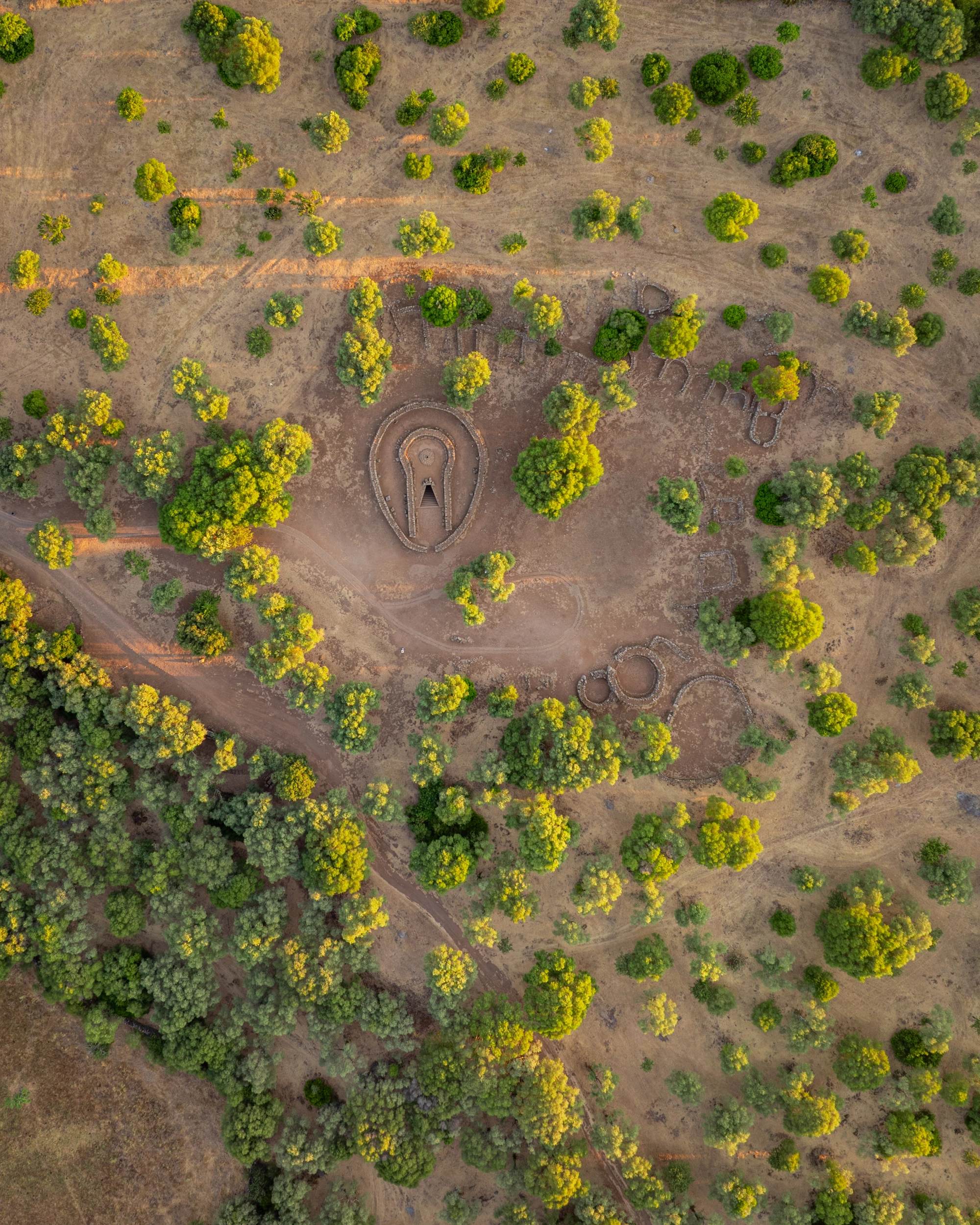
The Sacred Well of Santa Cristina is among the best-preserved examples. Its structure includes:
- An elliptical vestibule, likely used for collective rites
- A monumental staircase, symbolically accompanying the descent into the underground world
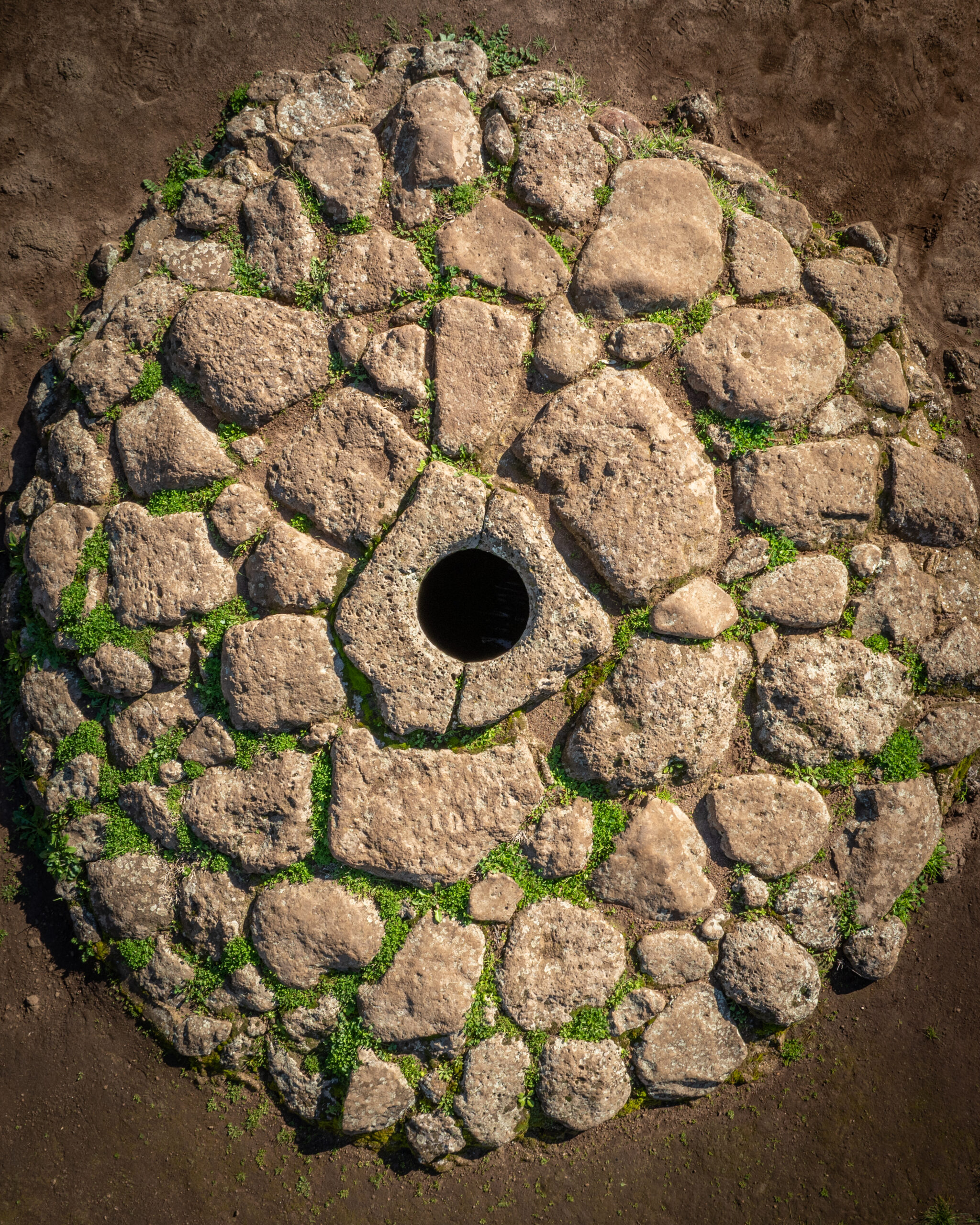
- A circular hypogean chamber, built with perfectly squared stone blocks, at whose center the spring water shines
This architecture did not respond to practical water-supply needs—far more easily solved with simpler systems—but rather to ritual and symbolic intentions. Descending the staircase meant undertaking a journey toward the divine.

Ritual Practices Connected to Water
Archaeological evidence—bronze figurines, miniature weapons, ceramics, and ritual offerings—found in various Nuragic sanctuaries reveals multiple ritual functions linked to water:
- Purification and healing: water was considered a source of physical and spiritual regeneration.
- Oracular and divine judgment: as in the ordeals mentioned by Solinus, deities were believed to express their will through water.
- Astronomical rites: some studies suggest that the well’s construction allowed celestial phenomena to be observed reflected in the water, uniting sky and earth in a single sacred space.
- Votive deposits: bronze objects, ceramics, and precious items were cast into the water as offerings to underground deities.
Federal Sanctuaries and the Political Dimension of Worship
According to Giovanni Lilliu, one of the leading scholars of Nuragic civilization, sanctuaries with sacred wells were not isolated places but true federal sanctuaries where multiple communities gathered.
In these contexts, water stood at the center of religious rites, while the sanctuary also served as a venue for:
- Political alliances between different communities
- Commercial exchanges, with the display and distribution of goods
- Displays of power by elites, who demonstrated their status through offerings
More recent studies by scholars such as Moravetti, Ugas, Lo Schiavo, and Fadda emphasize this broader function: sacred wells were not only temples but also major economic and political centers.

Climate Crisis and the Birth of the Cult
An intriguing historical element concerns climate. The emergence of sacred wells coincided with a period of severe drought in the Mediterranean during the 12th century BC. Water scarcity made the protection and control of springs crucial, but also led to the sacralization of the element itself.
In this context, water became both deity and object of worship, as rituals sought to ensure its continued presence and abundance.
The Sacred Well of Santa Cristina and the Spiritual Meaning of Water
The Sacred Well of Santa Cristina encapsulates all these dimensions:
- It is sacred architecture, with the staircase symbolizing descent into the womb of the earth.
- It is a temple of water, where the liquid element was not for daily use, but for communion with the divine.
- It is a communal space, where religion, economy, and politics intertwined.
Even today, its suspended atmosphere, the reflection of light on the water, and the perfection of its architectural lines convey a sense of mystery that speaks of ancient rites and beliefs.
The cult of water at the Sacred Well of Santa Cristina offers a vivid and complex image of Nuragic civilization. Water—essential for survival—became at the same time a symbol of life, purification, and power.
Visiting the site means not only admiring an extraordinary architectural work, but also entering into contact with one of the deepest expressions of spirituality in ancient Sardinia.